
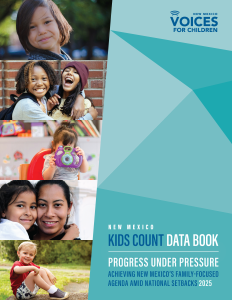
 Progress Under Pressure: Achieving New Mexico’s Family-Focused Agenda Amid National Setbacks
Download the full data book (April 2026; 83 pages; pdf)
Find more data for New Mexico and the U.S. at the KIDS COUNT Data Center
Introductory Essay
In 2024, years of power building, collaboration, advocacy, and bold leadership in New Mexico began to pay off. Families, children, and communities in our state are now feeling the impact of a family-focused agenda in their lives, and their stories are proof that when we put children first, policy can transform lives. By expanding state tax credits for working families, enacting paid sick leave, and securing permanent funding for early childhood programs, we’ve made considerable progress in fighting poverty in New Mexico.
The Supplemental Poverty Measure (SPM), which considers not just family income, but also the cost of basic necessities and the support provided by government programs, shows how much these policies are making a difference. New Mexico’s SPM child poverty rate is just 10.3%, lower than the national average of 13.1%. Our state also has the greatest child poverty rate reduction after taking into account our income support programs and policies – a 19 percentage point decrease from our Official Poverty Measure child poverty rate.
Despite these improvements, many barriers remain that keep our youngest New Mexicans from thriving and reaching their unique potential. These generational challenges demand multi-faceted solutions, and require us to measure them in a way that reflects the full scope of what our children and families need.
We know that lasting policy progress can be fragile, and in 2025, that reality became painfully clear across the entire nation. On July 4th, 2025, President Trump signed the budget reconciliation bill (the One Big Beautiful Bill Act, or the OBBBA), which, along with his proposed budget, prioritizes massive tax breaks for corporations and the ultra-wealthy while making devastating cuts to the programs and services that have helped children and families access public education, stay healthy, and make ends meet for generations.
For New Mexico, the stakes are high and the impact is immediate. The OBBBA strips lifelines like Medicaid from around 98,000 New Mexicans, and some or all SNAP benefits from 68,000 families. It expands a cruel and costly carceral system instead of reforming our immigration system for the 64,000 New Mexico immigrants who are our friends, neighbors, colleagues, and contributors to our state economy and tax base. It rewards the ultra-rich while ignoring the needs of those working hardest to make ends meet.
The OBBBA is only one part of the broader attack on the federal infrastructure that large-scale policy efforts to improve child well-being have depended on for decades. The U.S. Census, an indispensable tool for allocating public resources and guiding both state and federal policy, faces threats to its funding, independence, and accuracy. The same is true for many other long-standing federal data sources that inform data-driven child and family policy efforts nationwide.
In the face of a federal policy agenda that actively hurts the health and opportunity of working families and vulnerable children, advocates and legislative champions are pushing back. In October 2025, the Governor and the New Mexico Legislature convened a special session to address the most immediate impacts of the OBBBA. Lawmakers took the first steps to protect SNAP benefits for older adults and immigrants at risk of losing access, provided support for New Mexico food banks to meet some of the increasing need, and ensured that people purchasing health insurance through the BeWell Exchange will not be forced to pay dramatically higher insurance premiums. This work is only the beginning though, as the most harmful provisions of the OBBBA are set to take effect in the coming years.
In spite of these unanticipated pressures from the federal government, New Mexico continues to prove that big, bold action on behalf of child well-being and family economic security is still possible. The state reached a historic milestone by announcing it will be the first in the nation to offer free child care to all families regardless of income, saving families an average of $12,000 per year per child. New Mexico was also one of the first states to adopt universal free school meals, and our legislature has taken steps to stabilize our budget by creating trust funds that will help the state weather financial downturns without the deep cuts and austerity measures of the past.
Looking forward, New Mexico must work to ensure that our strong family- and child-centered state policies are well implemented while we remain vigilant and take proactive action to address federal policy changes that threaten the progress we have made. And while progress made through strong tax credits, government programs, and visionary policies like universal child care give us cause to celebrate, there is still much work to be done, especially in the areas of housing, health care, and K-12 education. It is as important as ever for advocates, communities, and policymakers on the state and local level to measure and understand child well-being, particularly the impact of diminished federal programs.
New Mexico’s KIDS COUNT Story
KIDS COUNT is a nationwide effort to track the status and well-being of children in each state and across the nation by measuring indicators in four areas – economic well-being, education, health, and family and community – for which you’ll find data in this publication. You’ll also find policy recommendations in each area for improving outcomes. KIDS COUNT is driven by research showing that children’s chances of being healthy, doing well in school, and growing up to be productive and thriving members of society can be influenced by their experiences in the early years.
At its heart, KIDS COUNT tells a story of child well-being that’s set against a backdrop of the opportunities we’ve made available to our kids. And while the data included in this publication are important and useful, they don’t tell the whole story. We often don’t see the lived experiences of all communities accurately reflected in these numbers. Many of us have been taught that data are objective, and that the numbers we see reflected in statistics are unequivocally true. But choices are made throughout the data collection process that not only prevent them from reflecting our strengths, but that also limit, erase, and devalue the lived experiences of many groups including the LGBTQ+ community, immigrants, Tribal communities, and many communities of color, particularly Black and Asian communities here in New Mexico.
The data also paint a picture of child well-being from a deficit perspective – a perspective that sadly ignores the extraordinary resilience, unmeasured strengths, and many successes of our children, families, and state in the face of deeply embedded systemic challenges. That story can be found among New Mexico’s unique cultural and linguistic diversity, centuries-old traditions, and our enduring sense of community.
The data also tell us where we have been rather than where we are now or where we are going. When all is said and done, KIDS COUNT is a snapshot – an accurate, if incomplete, picture of one point in time. For policymakers and advocates alike, it is an invaluable tool meant to make us take stock of how well we are protecting and nurturing our greatest asset – New Mexico’s children.
A Note About Data
Wherever possible, data are disaggregated to help provide a clearer understanding of disparities by race and ethnicity. In the past, New Mexico Voices for Children has reported data sets from organizations that suppress data for some races because the data are derived from small sample sizes, meaning the estimates are less accurate. We recognize this as problematic given our country’s long history of cultural erasure and New Mexico’s tricultural myth that typically implies only Hispanic, white, and Native American communities make up our population in the state and that these racial and ethnic groups have most often lived in relative harmony with one another throughout history. In response, we are including 2023-2024 data disaggregated by all available races and ethnicities when possible. These data will include a note regarding high margins of error for smaller demographic groups so readers are aware that some estimates may be less reliable than others while still providing insight into how smaller communities of color are faring in the state. Some rural and Tribal areas in New Mexico are also undercounted in U.S. Census data and can be underrepresented in other sources. As a result, the statistics throughout this report tell an even more limited story, and in some cases, the numbers don’t reflect people’s lived experiences. New Mexico Voices for Children is committed to continuing to engage with the communities represented in these data to better understand the stories, voices, and people behind the numbers. We are also committed to engaging with the communities left out of this data and advocating for better, more accurate, and inclusive data.