Tax Fairness & Budget Adequacy
The institution of government is the means by which we do things collectively that we could not do as individuals. One of the main functions of government – written into the Constitution – is to promote the general welfare by collecting revenue that is spent on public structures like schools, roads and bridges, and services like public safety, public health, and much more. How we collect and spend public money says a great deal about our moral objectives. Our tax and budget policies should be fair, responsible, and transparent, address income inequality, and generate sufficient revenues to support programs and services that improve our quality of life. Children and families should be a high priority in federal, state, and local budgets.
Featured Content

From Poverty to Prosperity: How Tax Credits Impact Child Poverty and Well-being
The second in a series of reports on how public benefits programs and tax credits impact poverty in New Mexico, this looks at how state and federal tax credits improve child and family well-being, including how many families benefit and how much money is refunded to them.
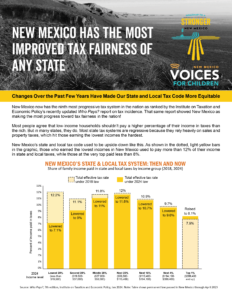
New Mexico has the Most-Improved Tax Fairness of Any State
New Mexico now has the ninth most progressive tax system in the nation as ranked by the Institute on Taxation and Economic Policy’s recently updated Who Pays? report on tax incidence. That same report showed New Mexico as making the most progress toward tax fairness in the nation! This fact sheet explains why.
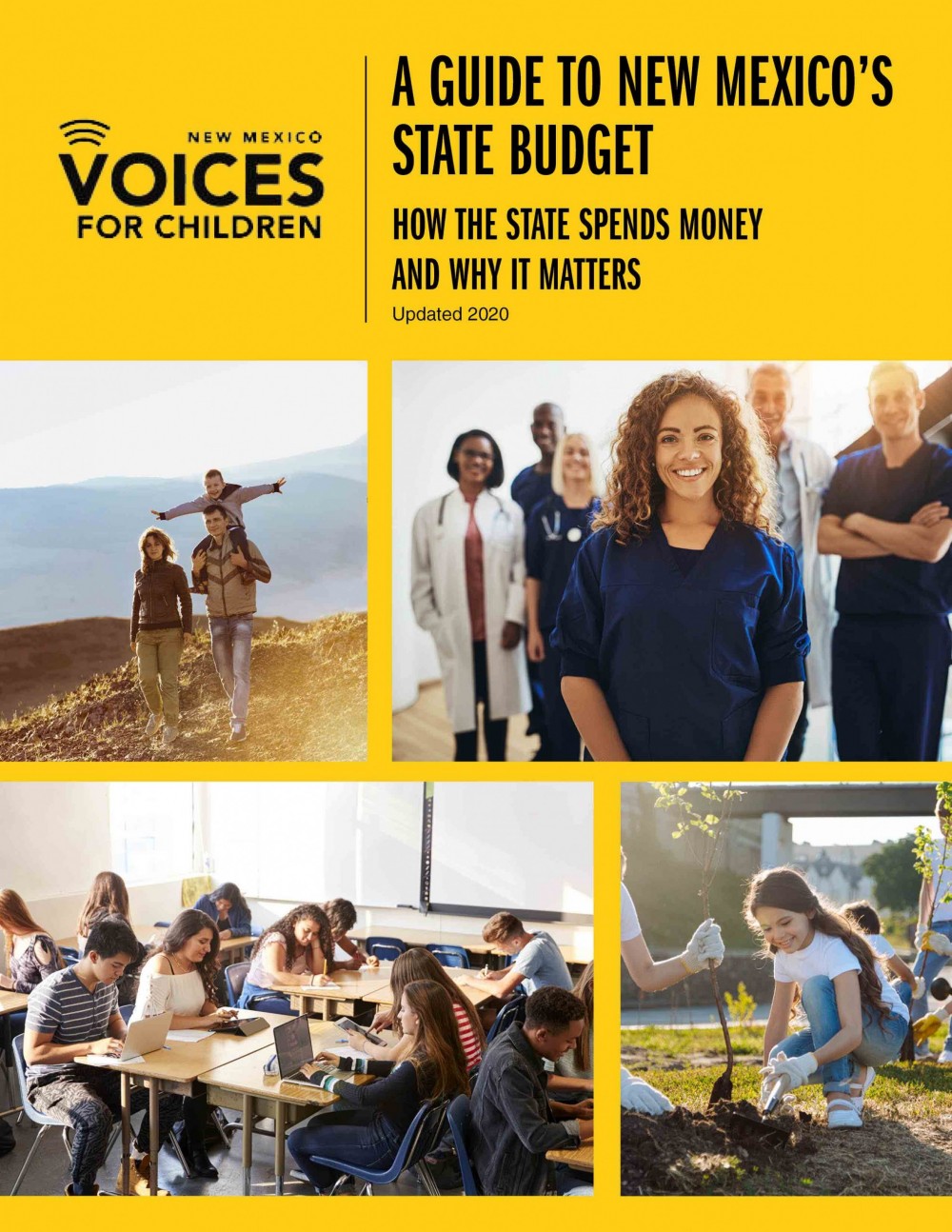
Your Go-To Guides on How the State Collects and Spends Money
Our state’s tax system and budget are a reflection of what we value most and an illustration of the kind of communities we wish to create. Who pays taxes and how much, and how we spend and allocate that funding – basically, how we make our values a reality – are decided by the lawmakers we elect to represent us in Santa Fe. They create the annual budget that the state uses to provide services that benefit us collectively, like education and health care.
- Link to the full Guide to New Mexico’s Tax System or the executive summary
- Link to the full Guide to New Mexico’s State Budget or the executive summary
Recent Publications
New Mexico Children’s Roadmap Report
Written by Emily Wildau, MPP, and Jonathan Salazar, M.Ed. [...]
2025 New Mexico KIDS COUNT Data Book
NM KIDS COUNT Data Book Critical investments in a family- and child-focused policy agenda have improved the lives of families and children in New Mexico, but federal changes threaten this progress. This annual report provides data on numerous child well-being indicators related to economic security, education, health, and family and community, and includes policy solutions. (State-, county-, tribal- and school district-level data on child well-being.)
Recent Blog Posts
LEGISLATIVE ROUND UP: Eliminating New Mexico’s Income Tax Would Be a Giveaway to Millionaires—and a Bad Deal for Everyone Else
Do we really want to bankrupt New Mexico’s state government to give millionaires an extra $150,000 a year while making life harder for the state’s lowest-income residents? That is the staggering implication of proposals to eliminate New Mexico’s personal income tax.
New Mexico is Protecting Healthcare Affordability
Boosting New Mexico’s healthcare fund is essential to keeping coverage affordable and helping families rise out of poverty. At the end of 2025, Congress failed to extend the enhanced premium tax credits that had helped millions of Americans afford health insurance through the Affordable Care Act (ACA). Their expiration threatened steep premium increases for tens of thousands of New Mexicans who rely on the ACA marketplace for coverage.
Recent News Coverage
New Mexico child advocacy group seeks input on closing gaps
Public News Service--A report by New Mexico Voices for Children shows 15 of the state's 33 counties don't have a single pediatrician, one of several facts included in the Children's Roadmap, which focused on three main areas, including education, health and economic security. It was released by the group earlier this year and is being discussed at statewide outreach meetings.
New Mexico Voices for Children takes latest report on the road
KRQE--The nonprofit organization New Mexico Voices for Children is holdings its New Mexico Children’s Roadshow, traveling across the state to hear firsthand the issues residents face when it comes to children and their families. The organization, in partnership with the W.K. Kellogg Foundation, produced a report that highlights how recent investments have improved opportunities for children in New Mexico and identifies ongoing challenges that children and families still face.
Programs, Coalitions & Networks
Economic Relief Working Group A coalition of several grassroots and advocacy organizations – many of them focused on immigrant rights – ERWG was formed in 2020 initially to secure pandemic relief for those New Mexicans who did not qualify for federal relief due to their immigration status. ERWG worked on getting an accurate 2020 Census count for the state, and has also worked on wages, voting rights, tax credits and child care assistance, and currently runs a guarantied basic income (GBI) pilot project for families with mixed immigration status.
New Mexico Fairness Project A coalition of more than 30 organizations, NMFP works to ensure that New Mexico collects tax revenue in a way that is equitable and sustainable, and that is adequate to fund the programs, services, and infrastructure that New Mexico’s children, families, communities, and businesses rely upon. Run by NM Voices, NMFP also fights for fair wages and working conditions, and other issues central to family economic security.
State Priorities Partnership (SPP), Economic Analysis and Research Network (EARN), and State Revenue Alliance (SRA) are three national initiatives in which we take part. SPP is a program of the Center on Budget & Policy Priorities (CBPP) and includes 31 state-level groups nationwide. EARN is a program of the Economic Policy Institute (EPI) and includes 55 groups from across the nation. A network of state-based community, labor, and policy advocates from across the country. SRA works with on-the-ground advocates, giving them the strategic resources they need to build intersectional, people-powered campaigns that transform revenue policy – ensuring our states fully fund communities and that corporations and the ultra rich pay what they owe.
New Mexico Civic Engagement Table A project of the Center for Civic Policy, NMCET unifies more than 40 diverse organizations from different sectors around a common agenda to strengthen our democracy. Among its issues are economic justice, early childhood education, climate justice, immigration reform, and economic development.
Resources
A Basic Family Budget Calculator is an important tool in determining if a family lives in poverty, because the system currently in place to do that is completely outdated.
Federal poverty guidelines, which dictate whether a family is eligible to receive assistance such as Medicaid and Food Stamps, are tied to a formula that was created in the 1960s. It was based on what the typical family spent on groceries because that was a family’s biggest expense at the time. Today, necessities like housing, childcare and health care take up a far greater share of most family incomes than groceries. Not only do the guidelines not take these changes into account, they do not take into account regional differences in the cost of living.
Because the federal guidelines are so inaccurate, families are generally considered low-income when they earn up to twice (or 200 percent) the poverty level. This makes up for some shortfalls in the guidelines, but they are still nowhere near as accurate as a Basic Family Budget.
Click here to find out the minimum amount families need to earn in order to live at a basic, no-frills level in New Mexico’s cities and counties.