 by Emily Wildau, MPP
Director of Policy
September 01, 2026
The Health Care Authority estimates that between 6-8 New Mexico hospitals will close as a result of this steep loss of funding.
Every person in New Mexico deserves access to health care. When families are able to access preventative care and manage chronic conditions, all family members are better off and our communities are healthier. As New Mexico prepares for the roll out of federally-required Medicaid work reporting requirements, another significant change is looming that stands to decimate the funding system that prevents primary care providers, hospitals, and other providers from closing their doors and worsening access to care for our families.
What are State Directed Payments?
Medicaid is a joint federal and state program providing health insurance to people with low incomes. In New Mexico, approximately 70% of Medicaid funding is federal dollars, with the remaining 30% coming from the state. State Directed Payments (SDPs) allow New Mexico to direct how managed care organizations (MCOs, the health care companies that manage payments for Medicaid recipients) pay for services. State law has established a provider tax and sets provider reimbursement rates equivalent to the average commercial insurance rates. This functionally works to incentivize more providers to accept Medicaid when more of the cost of care is reimbursed, meaning greater access to care for the nearly 40% of New Mexicans – and 61% of children – who are insured through Medicaid.
New Mexico leverages these provider taxes so the state can draw down federal funds and directs those funds back through SDPs while holding providers harmless, or offering safe harbor, for the initial tax up to a rate of 6%. There are SDPs for many types of providers, including tribal entities, hospitals, primary care practitioners, ambulances, and nursing facilities, but the greatest amount is spent on hospitals.
By leveraging provider taxes and using SDPs, New Mexico draws down an estimated $1.8 billion annually in federal funding that is then infused back into our state healthcare system by directing MCOs to make uniform rate increases for Medicaid reimbursement rates equal to the average commercial rate.
What’s Changing?
When H.R. 1, or the One Big Beautiful Bill Act (OBBBA), was signed into law in July 2025, it made significant changes to Medicaid that are designed to deeply cut federal spending on this critical health insurance program over the next decade. One component changes the maximum provider tax rates that states can levy to draw down federal funds to use for SDPs, and another changes the allowable maximum reimbursement rates that SDPs can require MCOs to pay in uniform rate increases for several different provider types.
The first change will mean New Mexico is required to reduce the existing tax rate on providers to a cap of 3.5% and will be prohibited from establishing any new provider taxes. Currently, the state’s provider tax is 6% of provider revenues, but this will be reduced by 0.5% per year until the cap is reached beginning in 2028.
The second significant change will decrease New Mexico’s ability to use SDPs for uniform rate increases through MCO reimbursement rates. Currently, New Mexico’s SDPs result in uniform rate increases for MCOs that require provider reimbursement rates be pegged to average commercial insurance reimbursement rates. This incentivizes more providers to accept Medicaid and increases community access to care. OBBBA requires that SDPs to hospitals and several other provider types must not exceed 100% of the reimbursement rates paid by Medicare. If the current proposed rule from CMS becomes final, New Mexico would no longer be allowed to use the uniform rate increase model. more provider types will be added under this cap. This will squeeze the bottom line of providers, who might respond by refusing to accept patients covered by Medicaid. New Mexico would also no longer be allowed to use the uniform rate increase model.
How do these changes cut health care for New Mexican families?
Because of the reduced tax rate, SDPs won’t be able to draw down the same amount of federal dollars unless the state backfills the lost revenue, leading to a significant reduction in the amount returned to hospitals. And if uniform rate increases are no longer allowable, states may not be able to use SDPs to provide supplemental payments through MCOs that are similar to fee-for-service Medicaid at all.
This means two things:
- Providers will receive significantly lower reimbursement for care provided to Medicaid patients, potentially to the point of no longer being financially able to serve these patients and limiting already low access to providers; and
- Those providers that still have significant percentages of their patients enrolled in Medicaid will lose funding to support the cost of services.
Currently, SDPs are a critical component of New Mexico’s total Medicaid budget of $12 billion. The state has three SDPs that serve as non-General Fund state match sources, with the one for hospitals being the largest. Together, these provide $1.8 billion or 15% of the total budget annually.
Changes to provider taxes and SDPs are set to begin January 1, 2028. This is estimated to reduce SDPs by 67% and the total state Medicaid budget by 10% – dropping from $1.8 billion to approximately $600 million by the time the changes are fully implemented (see Figure I).
Figure I: Changes to State Directed Payments Mean $1.2 Billion in Lost Medicaid Funding by 2037
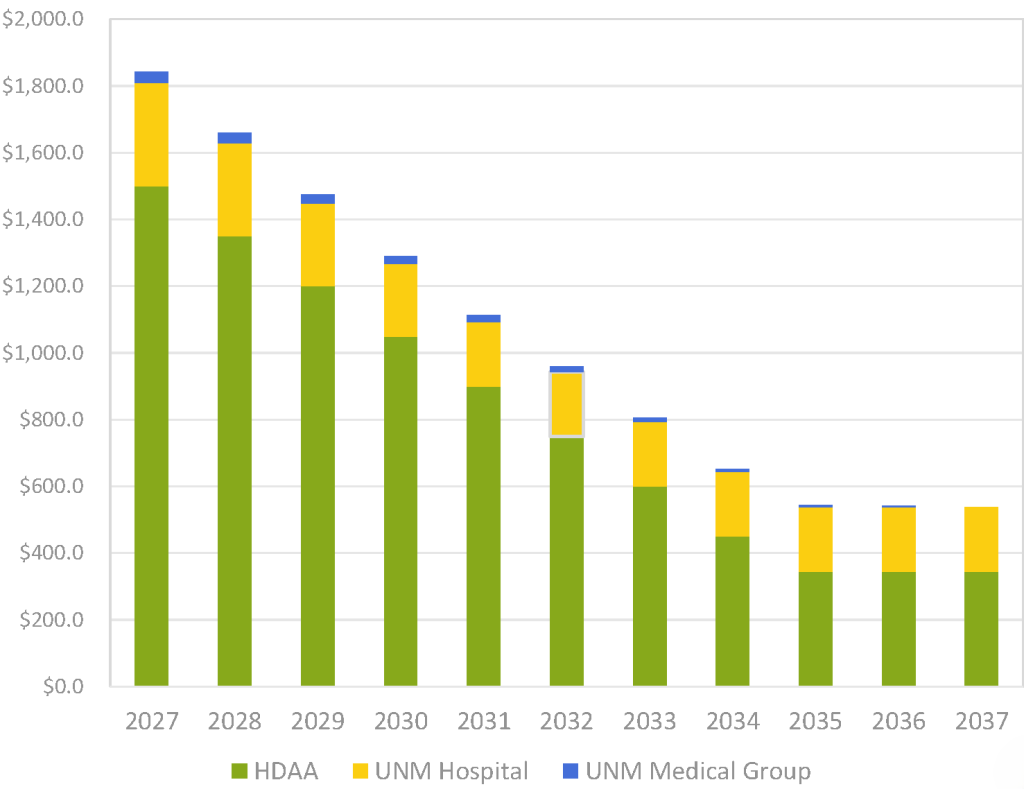
Source: New Mexico Health Care Authority, August 2026
The Health Care Authority estimates that between 6-8 New Mexico hospitals will close as a result of this steep loss of funding.
Along with lost access to care, the economic impact is estimated to cost 82,800 jobs and $3.9 billion in lost labor income (see Figure II).
Figure II: Cuts to State Directed Payments Hurt the Economy

Source: New Mexico Health Care Authority, August 2026